


DMVInvest is a regional real estate investment platform serving domestic and international buyers across DC, Maryland, and Virginia. The firm needed a backend that could scale with its growing customer base without the overhead of managing dedicated servers. ASCENDING designed and built a fully serverless application on AWS SAM, replacing a traditional single-server setup with an architecture that scales automatically and only charges for what it uses.
BackgroundA B2C Real Estate Platform Across DC, Maryland, and Virginia
DMVInvest is a customer-facing business that depends on timely property data delivery and reliable transaction processing at scale. DMVInvest (dmvinvest.com) connects investors with real estate opportunities across the DC-Maryland-Virginia region, guiding customers who target a minimum 6% APR through the full lifecycle of selecting, purchasing, managing, and operating their properties. As a B2C business, DMVInvest depends on accurately delivering property information at scale, processing a steady stream of transactions, and keeping customers informed through timely messages and emails about home deals. To support its expanding customer base, DMVInvest needed a dashboard and online presence that was cost-effective, flexible, and easy to operate.
The ChallengeA Single Dedicated Server with Capacity Guesswork and No Failover
The challenge is a legacy dedicated-server model that could not scale or recover gracefully as traffic patterns changed. DMVInvest originally ran its site on a static, dedicated server rented from GoDaddy or a similar provider, with separate services bolted on for database and email functionality. That setup was simple to stand up but increasingly difficult to operate as the business grew.
- Capacity planning was largely guesswork, leading to redundant, underutilized resources during off-peak hours.
- The dedicated server represented a single point of failure that could take the entire site offline if it failed.
- Lambda's 50 MB deployment package limit threatened to block functions that depended on multiple third-party libraries.
- Serverless CI/CD tooling was far less mature than traditional CI/CD, leaving fewer proven options to automate source, test, build, and deployment stages.
An AWS Select Consulting Partner for Serverless Architecture
ASCENDING is an AWS Select Consulting Partner staffed entirely by AWS-certified engineers, with deep experience in serverless and microservice architecture and AWS infrastructure automation across organizations of many sizes. ASCENDING and DMVInvest had already collaborated successfully on other engagements, giving both sides an established relationship and mutual trust that made ASCENDING the natural choice to lead the migration to serverless.
The SolutionAWS SAM Architecture with Lambda, API Gateway, and DynamoDB
The solution is a fully managed serverless architecture that separates frontend delivery, API orchestration, and data persistence into independent cloud layers. ASCENDING built each layer of the application independently and assembled them into a single serverless system, using Amazon CloudFront for the front end, Amazon API Gateway integrated with AWS Lambda as the back end, and Amazon DynamoDB as the database. This division of responsibility meant developers no longer had to manage networking, firewalls, CPU, memory, or storage — AWS handled availability, scalability, and security, while the pay-per-use model kept costs low.
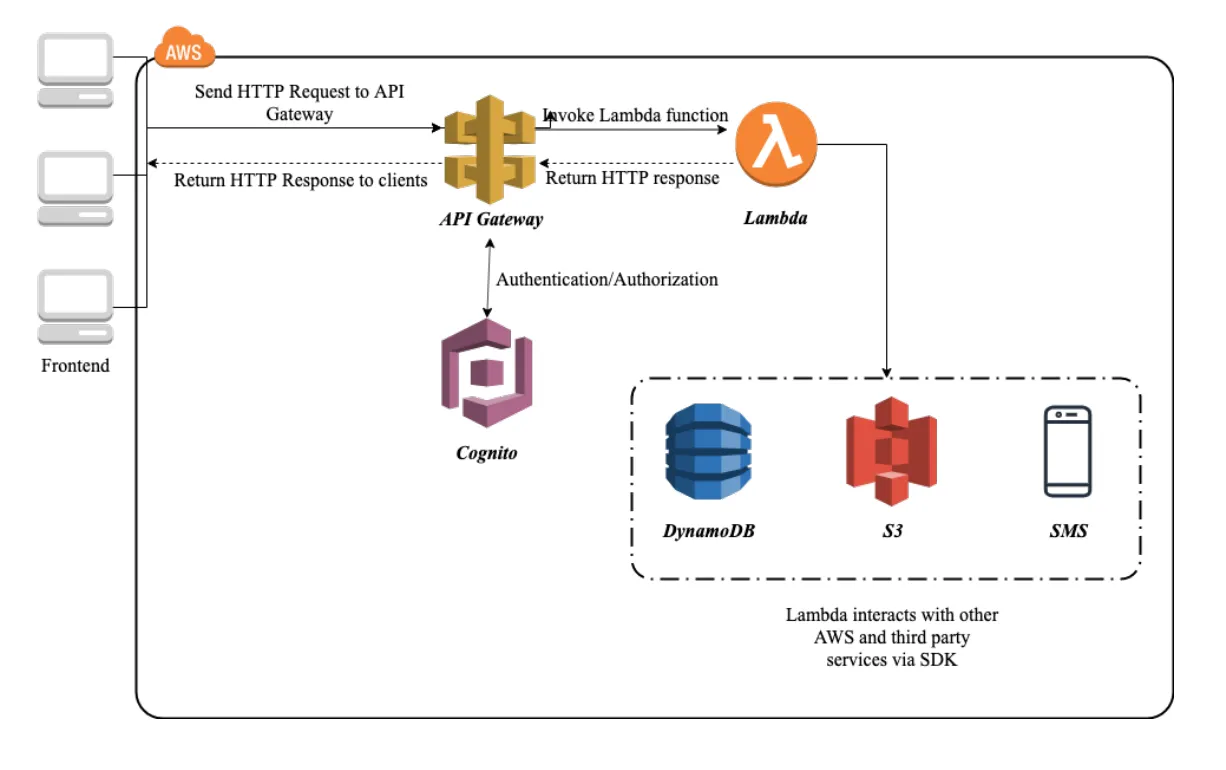
- Frontend clients send HTTP requests to Amazon API Gateway, which invokes the corresponding AWS Lambda function and returns the response back to the client.
- Amazon Cognito handles authentication and authorization for every request that passes through API Gateway.
- Lambda functions carry out the business logic — creating, updating, deleting, and searching property listings, with querying and pagination implemented directly against DynamoDB — then interact with other AWS and third-party services, including Amazon S3 and an SMS provider, via their SDKs.
- To work around Lambda's 50 MB package size limit, ASCENDING packaged shared dependencies into Lambda layers, keeping individual function deployments lean.
- ASCENDING used AWS CodeBuild alongside a generated
template.yamlto manage the serverless CI/CD pipeline end to end — source, test, build, and deployment — reducing the ongoing maintenance overhead of the release process.
The resulting environment runs more than 10 Lambda API functions alongside 3 scheduled Lambda jobs, covering everything from property CRUD operations to recurring background tasks.
The Outcome80% Lower Costs and No Single Point of Failure
The outcome is a resilient operating model that reduced infrastructure overhead while improving scalability and release consistency. Moving DMVInvest from a single dedicated server to a fully serverless AWS SAM application eliminated its single point of failure and gave the business a platform that scales automatically with demand.
- Cut the cost of managing servers, databases, and maintenance overhead by more than 80%.
- Removed the single point of failure inherent to the previous dedicated-server architecture.
- Standardized DMVInvest's application deployment process and gave the team clearer visibility into cloud resource usage, application load, and budget.
- Delivered a pay-per-use architecture that keeps costs low as DMVInvest's transaction volume grows.
Built with AWS Serverless Services
Frequently Asked Questions
How long does a migration from a dedicated server to AWS SAM usually take?
Timeline is a phased process that starts with architecture design and API decomposition, then moves through iterative releases so business-critical features can be validated before full cutover — for DMVInvest that meant more than 10 API functions and 3 scheduled jobs cutting over in staged releases with 0 dropped workloads.
How does serverless architecture keep operating costs lower over time?
Cost efficiency is driven by pay-per-use compute, managed services, and reduced infrastructure maintenance, so teams avoid paying for idle server capacity and manual operations overhead. For DMVInvest — whose customers target a minimum 6% APR on real estate investments — infrastructure spend now tracks actual usage, down more than 80% from the dedicated-server era.
What does ASCENDING do to keep deployments reliable in a serverless stack?
Reliability is built through infrastructure-as-code, automated build and deployment workflows, and service-level controls aligned with the AWS Well-Architected Framework — 1 generated template.yaml defines the entire stack across all 8 AWS services, so every environment deploys identically.
How does the architecture stay within AWS Lambda's limits?
Shared dependencies ship as Lambda layers to stay under the 50 MB zipped (250 MB unzipped) deployment limit, and functions run comfortably inside Lambda's 15-minute maximum execution window. The production environment spans more than 10 API functions plus 3 scheduled jobs, with Amazon DynamoDB serving queries at millisecond scale and Amazon Cognito authenticating every API Gateway request.