
Impossible Objects is a virtual production studio that depends on fast, reliable creative tooling to keep pace with demanding content production schedules. Impossible Objects, a pioneering virtual production company, needed its creative infrastructure to scale with fluctuating production demands without slowing down its artists. ASCENDING redesigned the studio's Perforce version control environment and layered in a serverless rendering solution on AWS Deadline Cloud, giving Impossible Objects a more efficient, scalable, and user-friendly production pipeline.
BackgroundAssessing a Scalable Creative Infrastructure for Growing Production Demand
Impossible Objects' infrastructure modernization is a studio-wide push to scale creative tooling without disrupting active productions. Impossible Objects was seeking solutions to enhance the scalability, performance, and workflow efficiency of its creative processes as it took on increasingly demanding high-performance content production work. ASCENDING was engaged to resolve existing technical challenges and design a new, scalable infrastructure, with the project focused on optimizing digital asset management and assessing a serverless rendering solution built on AWS Deadline Cloud.
The ChallengeVersion Control Overhead, Network Latency, and Rendering That Couldn't Scale
The challenge is a set of interlocking constraints spanning version control, network performance, and rendering capacity. Impossible Objects' production pipeline was constrained by version control overhead, network performance, and a rendering setup that couldn't flex with demand.
- Version Control Issues: Artists used Perforce for version control, but the existing setup was time-consuming and required manual configuration on each artist's workstation.
- Network Latency: Slow network performance affected collaboration between remote artists, impacting overall production speed.
- Rendering Scalability: The existing on-premise rendering solution lacked the flexibility and scalability to handle fluctuating production demands.
AWS Infrastructure Expertise Paired with Creative Pipeline Automation
ASCENDING is an AWS-focused engineering partner with hands-on experience automating creative production pipelines. Impossible Objects needed a partner who could both modernize an entrenched creative tooling workflow and design cloud infrastructure capable of scaling rendering on demand. ASCENDING brought the AWS infrastructure expertise to redesign the studio's network architecture and integrate AWS Deadline Cloud, alongside the automation skills needed to eliminate the manual Perforce setup slowing artists down.
That combination of creative-pipeline familiarity and AWS cloud depth positioned ASCENDING to address both the version control and rendering challenges as part of one connected solution rather than two separate fixes.
The SolutionAutomated Perforce Setup and Serverless Rendering on AWS Deadline Cloud
The solution is a two-part architecture that automates version control setup and adds elastic, serverless rendering capacity. ASCENDING delivered a comprehensive solution addressing both Impossible Objects' Perforce environment and its rendering infrastructure.
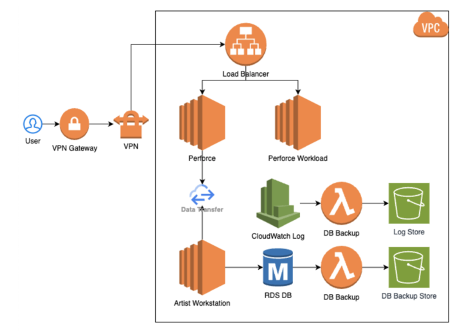
- ASCENDING developed a PowerShell script that automated the setup of Perforce on artists' workstations, letting artists begin content creation immediately instead of configuring their environment manually.
- To resolve network latency, ASCENDING redesigned the architecture with a P4 Proxy setup, significantly reducing latency, improving collaboration between remote artists, and making the system more scalable for future growth.
- ASCENDING designed a serverless rendering solution using AWS Deadline Cloud, allowing rendering resources to scale automatically based on demand.
- Proper IAM roles were configured across the environment to ensure secure, role-based access to both the rendering and version control systems.
A Faster, More Scalable, and More Collaborative Production Pipeline
The outcome is a production pipeline that scales with demand while cutting manual setup work for artists. The new Perforce architecture and serverless rendering design transformed Impossible Objects' production capabilities, giving artists a faster, more collaborative, and more scalable environment to work in.
- Enhanced workflow efficiency, with artists able to start working faster thanks to the automated Perforce setup and significantly reduced setup time.
- Reduced network latency through the P4 Proxy setup, enabling smoother collaboration and content creation across remote locations.
- Gained a highly scalable, flexible rendering solution with AWS Deadline Cloud that dynamically adjusts to workload demands, optimizing performance while reducing cost.
- Established a more efficient, scalable, and user-friendly environment for Impossible Objects' ongoing creative processes.
Built with AWS Serverless Rendering and Media Infrastructure
Frequently Asked Questions
How long does it take to automate Perforce setup and add serverless rendering for a virtual production studio?
Timeline is a phased engagement that typically starts with automating workstation setup, then layers in the serverless rendering environment once the version control architecture is stable in production.
How is access to rendering and version control systems secured?
Security is enforced through IAM roles scoped to each system, giving artists and automation scripts only the permissions they need to interact with the Perforce environment and the rendering pipeline.
How does serverless rendering handle sudden spikes in production demand?
Scalability is handled automatically by AWS Deadline Cloud, which provisions rendering capacity on demand and scales it back down once jobs complete, avoiding the fixed-capacity limits of an on-premise render farm.