

Vegogarden is a retail and e-commerce business that runs AI agents to support both its customers and its internal teams. Vegogarden had proven that AI agents could take real work off its teams' plates, but the bill grew every time another employee needed access. ASCENDING moved Vegogarden's AI agents off per-seat OpenAI licensing and onto a self-hosted platform built on Amazon Bedrock AgentCore and ASCENDING's Jarvis Registry, cutting AI costs 50%, cutting support workload 70%, and giving every team a choice of AI model instead of just one.
BackgroundCustomer-Support and Data-Analytics AI Agents on Per-Seat OpenAI
Vegogarden is a company whose customer-support and data-analytics teams both depend on always-on AI agents, originally licensed entirely through OpenAI. Vegogarden runs two AI-driven workloads day to day: a fleet of customer-support agents that look up product information and place orders on behalf of shoppers, and a set of data-analytics agents that give internal teams natural-language access to sales, inventory, and operations data. Both started on the OpenAI API, licensed per seat, so every additional support specialist, analyst, or engineer who needed access added another recurring per-person fee.
That model worked while adoption was small. As more of Vegogarden's teams leaned on the agents for daily work, the cost of giving people access started climbing in lockstep with headcount, regardless of how much or how little any one person actually used the tools.
The ChallengeAI Costs Scaling with Headcount and Single-Model Vendor Lock-In
The challenge is a licensing and architecture model that tied Vegogarden's AI costs to headcount and locked every workload to a single model provider. Vegogarden needed its agents to keep working exactly as teams expected, while fixing the economics and flexibility of how they were licensed and hosted.
- OpenAI's per-seat pricing meant AI costs scaled with headcount rather than with actual usage, making it expensive to extend access broadly.
- The business was locked into a single model provider, with no easy way to route different kinds of work to whichever AI model handled it best or most affordably.
- Support specialists and analysts needed to keep reaching the same agents from the everyday tools they already worked in, with no disruption during the switch.
- Every team's access needed to stay scoped to their own data and tools, so a support agent couldn't reach financial data and an analyst couldn't place customer orders.
An AWS Generative AI Competency Partner Behind Jarvis Registry
ASCENDING is an AWS Advanced Consulting Partner with Generative AI Competency, and its Jarvis Registry is purpose-built for moving AI agents off a single vendor's hosted platform and into a customer's own AWS environment without losing the experience teams already rely on. Because Jarvis Registry deploys directly inside Vegogarden's own infrastructure and connects natively to Amazon Bedrock AgentCore, ASCENDING could offer a genuine host-based alternative to per-seat licensing, not a workaround bolted onto the old model.
That combination, deep AWS Bedrock expertise plus a governed platform that speaks the same protocols every major AI copilot uses, made ASCENDING the right partner to move Vegogarden off OpenAI while keeping both agent workloads running for the people who depend on them every day.
The SolutionSelf-Hosted Multi-Model AI Agents on Amazon Bedrock AgentCore
The solution is a self-hosted, multi-model agent platform that replaces per-seat OpenAI licensing with Amazon Bedrock AgentCore and Jarvis Registry. ASCENDING migrated Vegogarden's customer-support agent fleet and data-analytics agents from OpenAI to Amazon Bedrock AgentCore, with Jarvis Registry sitting between the agents and the everyday tools Vegogarden's teams use.
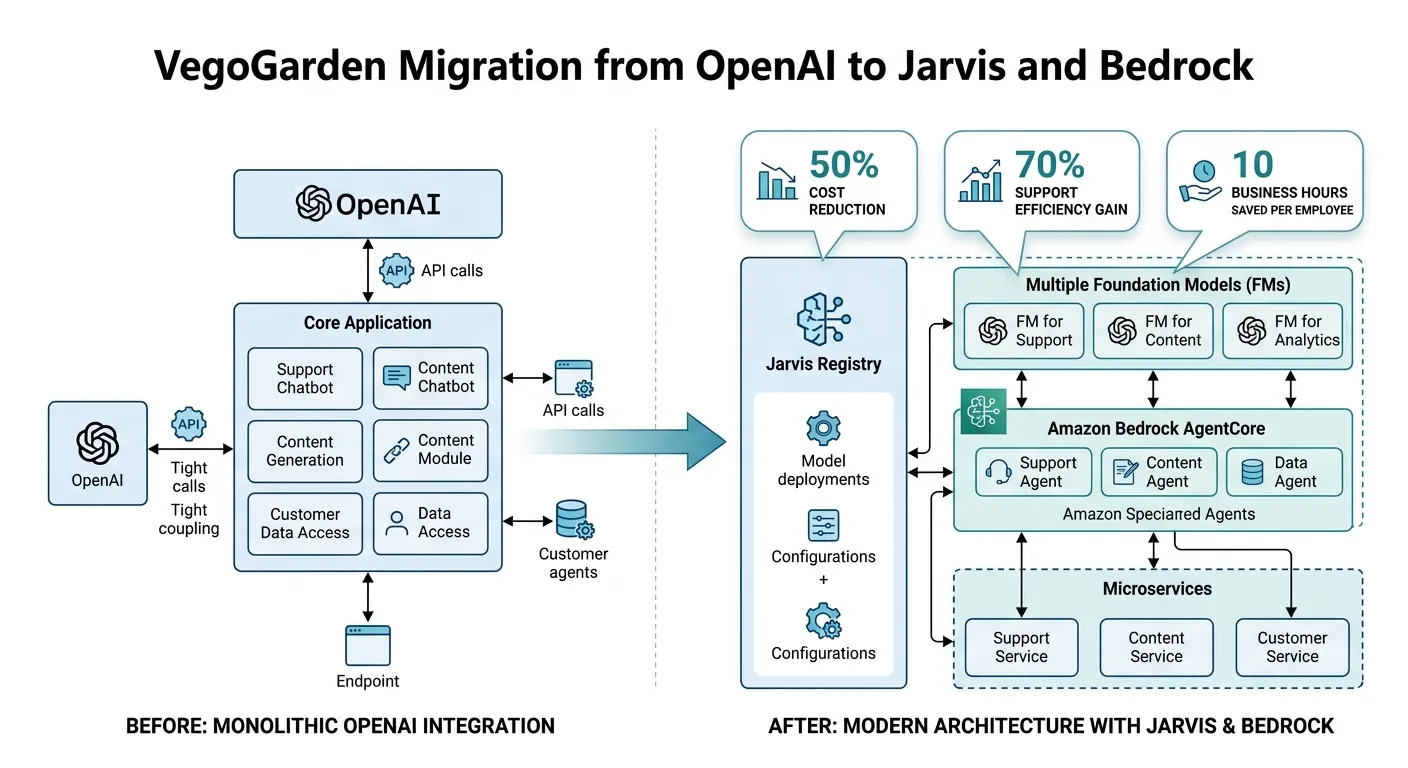
- Both agent workloads were rebuilt on Amazon Bedrock AgentCore, with Jarvis Registry providing the identity, discovery, and access layer that lets each agent be reached safely from the tools people already use, including Claude Desktop and VS Code.
- Instead of a single OpenAI model, agents now run on Anthropic Claude, AWS Nova, or Mistral through Amazon Bedrock, so Vegogarden can route each type of task to whichever model fits it best rather than being tied to one provider.
- ASCENDING tied the platform into Vegogarden's identity provider once, so every team member signs in with the credentials they already use, and access to each agent and its underlying data is scoped by role, department, and job function.
- Because Jarvis Registry runs inside Vegogarden's own AWS environment and is billed by the infrastructure it runs on, adding another support specialist or analyst no longer means adding another per-seat license fee.
50% Lower AI Costs and 70% Less Support Workload
The outcome is a lower-cost, multi-model AI platform that scales with infrastructure rather than headcount. Moving off per-seat OpenAI licensing gave Vegogarden a hosting model that scales with infrastructure rather than headcount, multi-model flexibility, and a substantial jump in day-to-day efficiency.
- Cut AI licensing costs 50% by replacing per-seat OpenAI pricing with a self-hosted platform billed on infrastructure, not headcount.
- Cut support ticket handling and related workflow time by 70%, as support specialists and analysts resolved more of their own requests directly through their agents.
- Saved each employee roughly 10 business hours by removing manual lookups, report generation, and back-and-forth previously needed to get answers from OpenAI-based tools.
- Gained the flexibility to run agents on Anthropic Claude, AWS Nova, or Mistral instead of a single vendor's models, choosing the best fit for each task.
- Preserved department-scoped access, so support, analytics, and engineering teams each reach only the agents and data relevant to their work.
- Kept both agent workloads reachable from the same everyday tools teams already used, with no disruption during the migration.
Built with Jarvis Registry on AWS Bedrock AgentCore
Frequently Asked Questions
How long does a migration from OpenAI to Amazon Bedrock AgentCore typically take?
Timeline depends on how many agent workflows need to be rebuilt, but Vegogarden's 2 agent workloads — customer support and data analytics — were migrated with 0 disruption to the everyday tools teams already used to reach them, from Claude Desktop to VS Code.
Does moving off per-seat OpenAI licensing mean giving up model quality or choice?
Model choice actually improves, since Amazon Bedrock lets Vegogarden route each task to Anthropic Claude, AWS Nova, or Mistral instead of being locked into a single provider.
How is access to sensitive data controlled across support and analytics agents?
Access is scoped by role, department, and job function through Vegogarden's identity provider, so support agents can't reach financial data and analysts can't place customer orders.
Does self-hosting AI agents on AWS increase operational overhead?
Overhead didn't increase — Jarvis Registry runs inside Vegogarden's own AWS environment and is billed by infrastructure rather than per-seat licenses, so adding new users adds 0 new recurring fees: the same infrastructure bill covers a team of 10 or a company of 100.
How much did migrating from OpenAI to Amazon Bedrock save?
The move cut AI licensing costs 50% and support workload 70%, while saving each employee roughly 10 business hours previously lost to manual lookups and report generation. Amazon Bedrock's multi-model catalog — more than 100 foundation models — lets Vegogarden route tasks across 3 model families (Anthropic Claude, AWS Nova, and Mistral) instead of paying per seat for 1 provider.