
Jarvis AI
Talent Solutions
Public Sector
About
Contact Us
image
Frequently Asked Questions

Everything you need to know
about the MCP Gateway

Answers to common enterprise questions about MCP discovery, governance, federation, OAuth, auth elicitation support, and observability. Can't find what you're looking for? Schedule a call.

Overview

About the MCP Gateway

An MCP gateway is the control and enforcement layer between AI clients and MCP servers. It centralizes 5 concerns for every MCP tool call: discovery, authentication, policy checks, routing, and auditing.

Instead of configuring each copilot directly against each MCP server, you expose 1 governed endpoint and enforce consistent policy for all clients.

The MCP Gateway focuses on tool, resource, and prompt invocation against MCP servers. The Agent Gateway focuses on autonomous agents and agent-to-agent orchestration.

Both are part of Jarvis Registry and share identity, policy, and observability controls, but they operate on different runtime objects and invocation models.

Federation

Multi-cloud MCP federation

No. MCP federation imports existing MCP servers from AWS AgentCore and Azure AI Foundry into the Jarvis catalog without redeployment.

Servers continue running in their source environment while Jarvis applies unified RBAC, ACL, and audit policy at the gateway layer.

Jarvis connects to each provider, discovers MCP servers and capabilities, and syncs them into one governed namespace. Each imported server is then exposed through the same gateway endpoint used by native servers.

From the client perspective, cloud origin is transparent. Discovery and invocation behavior stays consistent across self-hosted, AWS, and Azure MCP servers.

Auth & Elicitation

Authentication and auth elicitation support

Yes. Jarvis supports auth elicitation flows so MCP clients can be prompted to complete required authentication when a downstream server requires user consent or refreshed credentials.

This allows secure per-user authorization without exposing raw credentials to the client or bypassing enterprise identity policy.

Yes. The MCP Gateway validates resource indicators for token scope binding so a token intended for one MCP server cannot be replayed against another.

Jarvis enforces PKCE and standards-based OAuth behavior for inbound and outbound flows, including per-user token lifecycle controls.

Tokens and secrets are encrypted at rest and used server-side within your environment. Credentials are isolated per user and per downstream MCP server.

Silent refresh and revocation-aware handling ensure stable access while maintaining least-privilege posture and auditability.

Governance

Policy, access control, and audit

Jarvis applies RBAC and ACL policy at tool level on every invocation. Users and service identities see only the tools they are authorized to discover and invoke.

Policy decisions are enforced at runtime and captured in the audit stream for compliance review.

Yes. You can scope policy by role, group, environment, server, and individual tool actions. This supports strict separation across dev, staging, and production.

Central policy management avoids drift and keeps enforcement consistent across every connected copilot.

Operations

Observability and troubleshooting

Jarvis emits trace and audit telemetry for discovery and invocation events, including user identity context, policy decision, target server, and result status.

Telemetry is OTLP-compatible and can be forwarded to Datadog, Grafana, and other enterprise observability backends.

The most common causes are missing policy scope, expired downstream credentials, unsupported auth state, or schema mismatches between client input and tool contract.

Jarvis surfaces policy and auth failure details in logs so teams can quickly determine whether the issue is access, token state, or request format.

Because the gateway sits between clients and servers, the fastest rollback is a policy change rather than a redeploy: scope the affected tool out of the ACL and every client stops reaching it on the next invocation, with no client-side coordination.

The underlying server can then be fixed or reverted on its own schedule. Restoring the ACL entry brings it back, and the audit trail shows exactly which calls happened in the window between the two policy versions.

MCP Gateway specifications

A gateway that holds credentials for many downstream servers has to prove those credentials cannot be replayed across them. That is an authorisation-design question, so every row below names the specification that answers it.

Discovery, authorisation, elicitation, and telemetry specifications for the MCP Gateway.
SpecificationValue
ProtocolModel Context Protocol (MCP), published November 2024, over JSON-RPC 2.0
Server redeploys required0 — servers keep their host, runtime, and release cadence
Integration surface1 governed endpoint publishing every approved server
Base authorizationOAuth 2.0 (RFC 6749), Bearer usage per RFC 6750
Token scopingResource Indicators (RFC 8707) — a token minted for 1 server is not valid at another
DelegationOAuth 2.0 Token Exchange (RFC 8693)
Public-client flowsPKCE (RFC 7636)
Token formatJSON Web Token (RFC 7519), signed per RFC 7515
Auth elicitationSupported — downstream credentials can be requested mid-session
Identity federationOpenID Connect Core 1.0 and SAML 2.0
Access modelPer-tool ACL evaluated on every invocation
Rollback path1 policy change — no client-side coordination, effective on next invocation
Transport securityTLS 1.2 minimum, TLS 1.3 preferred (RFC 8446)
TelemetryOpenTelemetry OTLP — call, policy decision, and latency per invocation
Denial responsesHTTP 401 unauthenticated, HTTP 403 policy denial, HTTP 429 rate limited
Runtimes3 managed Kubernetes services — Amazon EKS, Azure AKS, Google GKE
Zero-trust referenceNIST SP 800-207 (2020)

Watch a governed MCP integration end to end

A worked example of 1 MCP server reached through the gateway — discovery, authorisation, and the resulting audit record — using GitHub as the connected system.

Jarvis x GitHub Integration | AI-Powered Analytics & Team Insights · 3 min 10 sec

MCP Gateway at a glance

The MCP Gateway is the component of Jarvis Registry that fronts Model Context Protocol servers. It is built by ASCENDING, an AWS Advanced Tier Services Partner. These 6 rows cover the questions that decide whether a gateway fits an existing MCP estate.

Reference facts for the Jarvis MCP Gateway, covering discovery, auth, federation, policy, and telemetry.
ConcernHow the MCP Gateway handles it
DiscoveryOne endpoint publishes every approved MCP server, so a client integrates once instead of once per server.
Existing serversMCP servers stay where they are. Registration is configuration only — no redeploy and no protocol shim.
AuthorisationOAuth 2.0 with resource indicators (RFC 8707), so a token issued for one MCP server is not replayable against another.
Auth elicitationSupported, so a tool can prompt for the downstream credential it needs mid-session instead of failing the call.
Access policyPer-tool ACL entries evaluated on every invocation, layered on top of Azure EntraID roles.
TelemetryAn OpenTelemetry collector captures each call, its policy decision, and its latency for troubleshooting and audit.

How to put a gateway in front of your MCP servers

Adopting the gateway does not require touching the MCP servers themselves, which is why most teams complete these 5 steps inside a single change window rather than a migration project.

  1. Deploy the gateway. Install Jarvis Registry into an existing Kubernetes namespace on Amazon EKS, Azure AKS, or Google GKE.
  2. Register the servers. Add each running MCP server to the catalog by endpoint; the server keeps its current host, runtime, and release cycle.
  3. Configure OAuth. Issue resource-scoped tokens per RFC 8707 so downstream credentials cannot be reused across tools.
  4. Scope the tools. Write ACL entries that expose each tool to the specific teams that need it, and nothing wider.
  5. Point clients at one endpoint. Repoint copilots and agents to the gateway URL, then confirm the OTEL trace shows the expected policy decisions.

Governance and discovery in practice

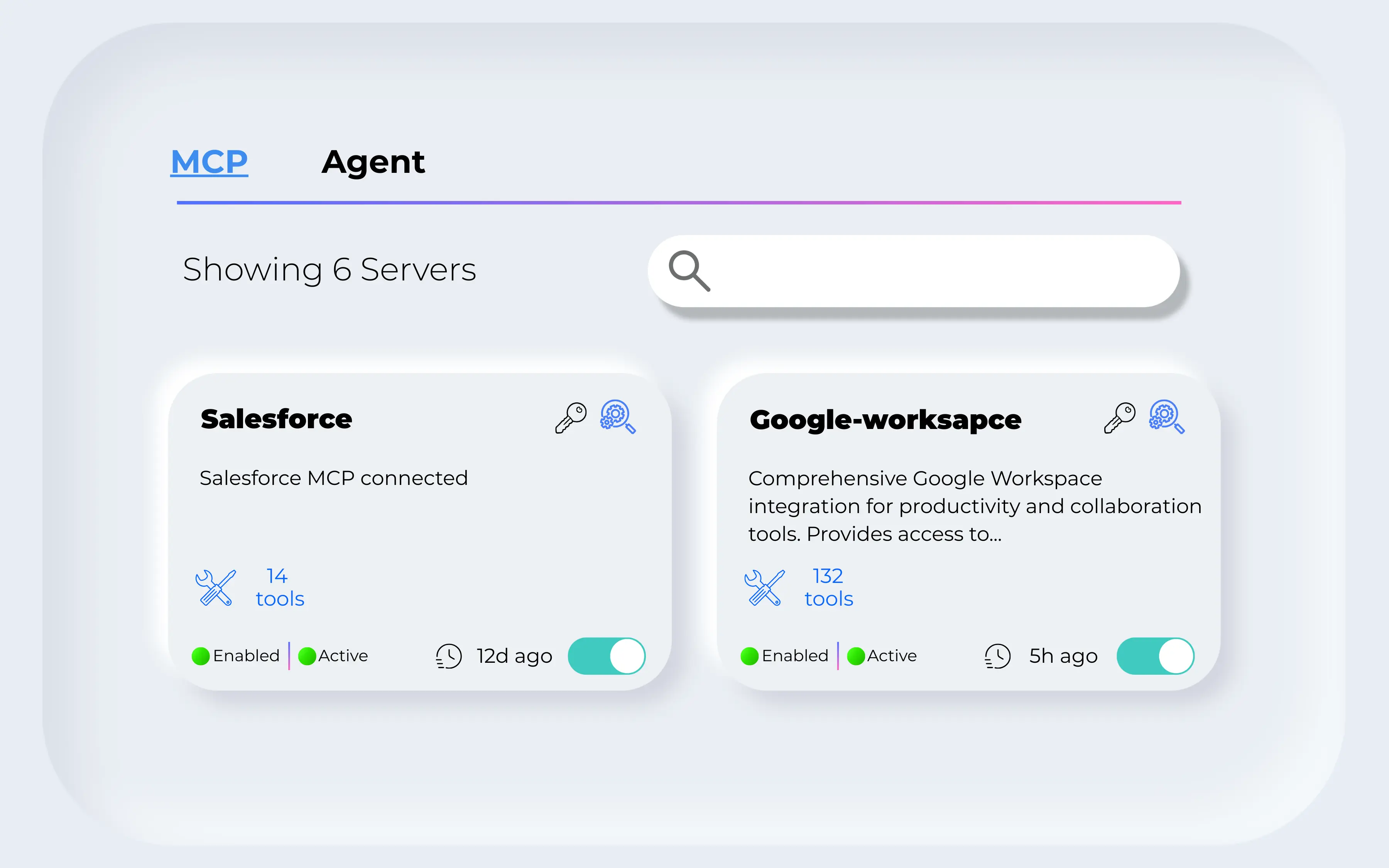
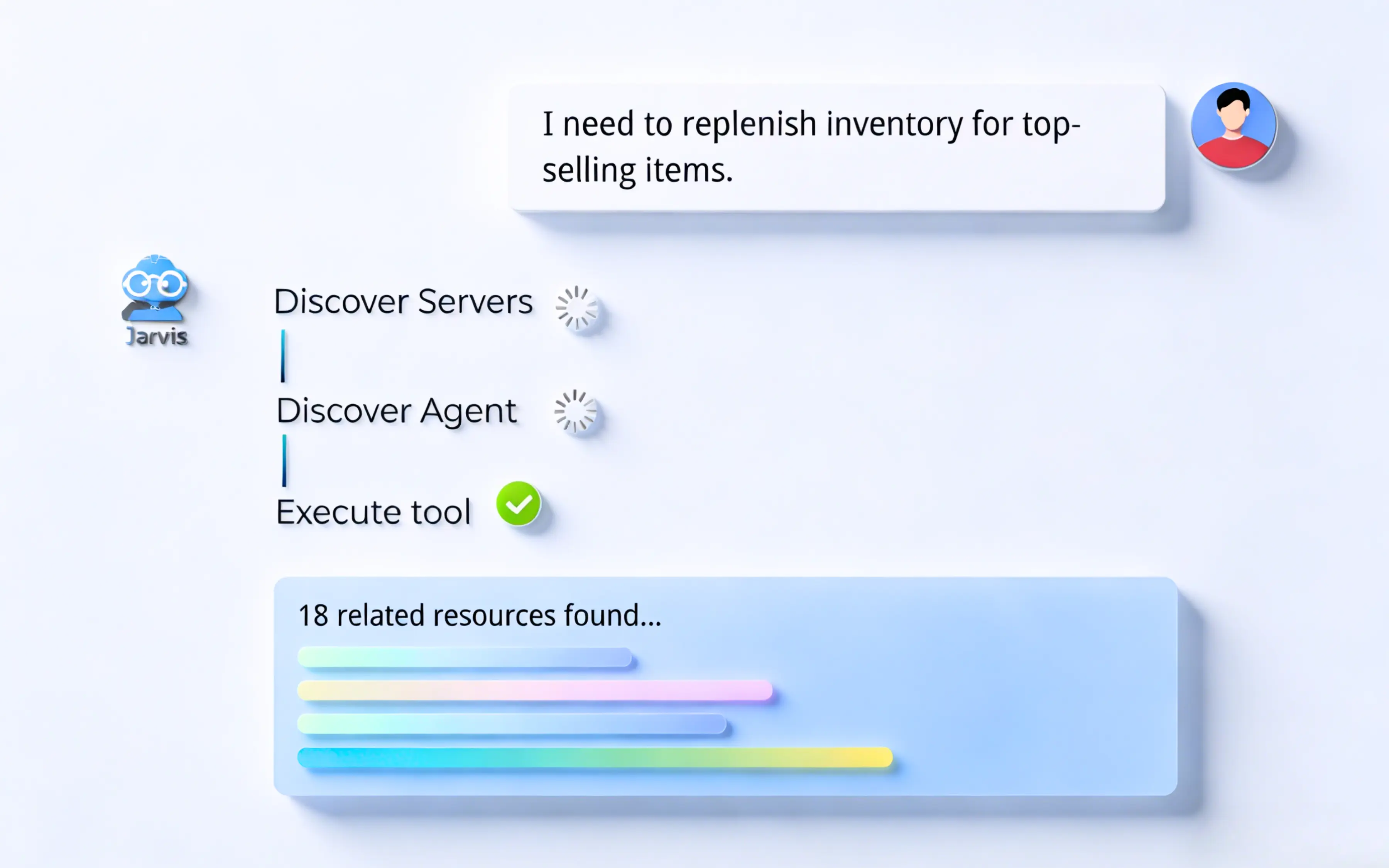
The gateway is where tool sprawl becomes a governed catalog: servers are discovered automatically, then exposed only through explicit policy.

Jarvis MCP Gateway governing access policy for enterprise MCP servers and tools
Policy is evaluated per invocation, not once at integration time.
Auto-discovery of enterprise MCP servers registered behind the Jarvis MCP Gateway
Auto-discovery keeps the catalog aligned with the MCP servers teams actually run.

Related Jarvis resources

The MCP Gateway and the Agent Gateway are the two halves of Jarvis Registry. These pages cover each in more depth.

Standards and references

The gateway implements published specifications end to end. These are the documents worth reading before an architecture review.

Still have questions?

Our team is happy to walk you through architecture, security, and pricing specific to your environment.